‘All change is loss’: developing grief literacy in the workplace
By Katie Koranda

“All change is loss, and all loss requires mourning.” - Harry Levinson
I was once on a project where a key leader was struggling with the change, exhibiting classic detractor behaviors that threatened the success of the project. And people were frustrated. Frankly, they were angry. “Tim is a problem. What do we do about him?”
As it turns out, Tim had recently experienced a death in his immediate family. I wondered, “Has anyone stopped to ask Tim what we do about Tim?”
Mourning is on the agenda
Early in the pandemic, McKinsey & Company’s leadership newsletter opened with this line: “tough times put mourning on the leader’s agenda.”
Six years later, it seems the agenda hasn’t changed. If anything, tough times have accelerated and compounded. And that’s to say nothing of the day-to-day workplace challenges posed by leadership transition, organizational change, and decreasing employee engagement.
Now layer in all the personal change and loss people in the workplace face. From colleagues receiving cancer diagnoses to pregnancy loss and caring for aging parents, people are dealing with a lot of loss on a lot of fronts.
At a certain point, all of these deeply human experiences accumulate, and we are left with an immeasurable amount of unresolved grief in the workplace.
At its most basic, McKinsey says, our experience of grief stems from our natural resistance to change. Resistance to change is part of the human condition. Grief is part of the human condition.
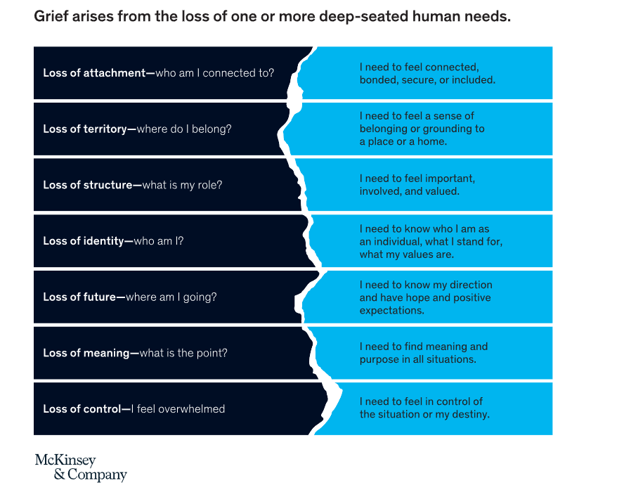
Remember our friend Tim? Even if he had not experienced a death in his family, experiencing a large-scale change at work can bring on a crisis of grief, as seen in the McKinsey graphic above. When we’re presented with leadership or organizational change, often what makes it so hard is that we’re really grappling with a loss of identity, territory, structure, control, and even meaning.
The true cost of workplace grief
According to McKinsey, 33% of senior executives have been affected by unresolved grief at some point in their careers. And, as the firm is wont to do, they’ve tacked on a cost: tens of billions of dollars per year in lost productivity and dampened performance, stemming from sapped energy and confidence levels, worsened health, and other lasting effects.
While the connection between grief and employee outcomes is undeniable, addressing the workplace mourning crisis is – more than anything – a matter of values and culture. Employees are whole people who deserve to be seen, valued, and cared for, whether or not they’re costing us money.
So, what do we do about it?
If you’ve read this far, you may have guessed that there are no easy answers, but the secret lies in approach. We can strategize and execute organizational change and build employee engagement frameworks, but that will never be enough if we aren’t applying effort to what’s happening between the lines, in the space that exists between our plans and our employees’ experiences.
Here are four ways to address grief in the workplace:
Increase your awareness
This one is easy because you’ve read this, so now you know the depth of loss people in the workplace face. You can also develop greater grief literacy. What does it look like to bring this awareness into your daily interactions? How could that affect the way you see people? Would it affect how you communicate?
Create space for grieving employees
Often people don’t recognize what they’re experiencing as grief. And it doesn’t have to be named to be acknowledged. But we all have an opportunity to slow down and really see each other. What would it look like to make space for your grieving coworker or employee in the midst of your busy day?
See grief in all its glory
Grief doesn’t just show up as sadness. It can manifest in many ways, including anger, fatigue, and memory loss. But grief is also a deeply sacred experience that can allow people to access greater depths, leading to empathy, creativity, and a renewed sense of meaning and connection.
Put people first
When we put people first in every initiative – when it’s more than a tagline – we’re making space for their full human experience. Putting people first immediately orients us to a way of working and leading that can handle everything workplace grief has to throw at us.
Grief exists in the workplace because people exist. When we put people first, we’re addressing grief by making space for them, listening to them, and letting them know that they matter beyond what they bring to the bottom line.

Katie Koranda is a seasoned communications professional with deep internal and external communications expertise at large, global, matrixed organizations across multiple industries. As a trained spiritual director specializing in grief and loss, she brings a unique perspective to communications, blending strategic narrative and visual storytelling with deep relational awareness.